Reducing Captain Engagement Time at Careem
Delivery time was creeping up and the team assumed routing. The real cause was arrival: Captains reaching the right coordinates and still not finding the door.

Careem's delivery reliability depends on Captain Engagement Time (CET): the time between a Captain accepting an order and completing it. Baseline CET averaged around 36 minutes and was trending upward in dense areas. Lower CET improves Captain earnings, which increases Captain supply, which improves delivery reliability and customer retention.
The team's starting assumption was routing inefficiency. My task was to investigate where the time was actually being lost before proposing a fix.
Session replays showed Captains reaching the correct coordinates and still searching for entrances. The issue wasn't routing, it was arrival: Captains misreading merchant locations, arrival events not being verified accurately, and location data itself being unreliable. Each needed its own fix.
Merchant Finder
The research team ran interviews and ride-alongs with Captains across two markets to understand how they actually located restaurants in malls and cloud kitchens. From that, I designed a guided arrival experience: landmark photos, entrance details, and parking guidance layered onto the existing flow. We piloted it with 20 to 30 Captains across high-traffic zones.
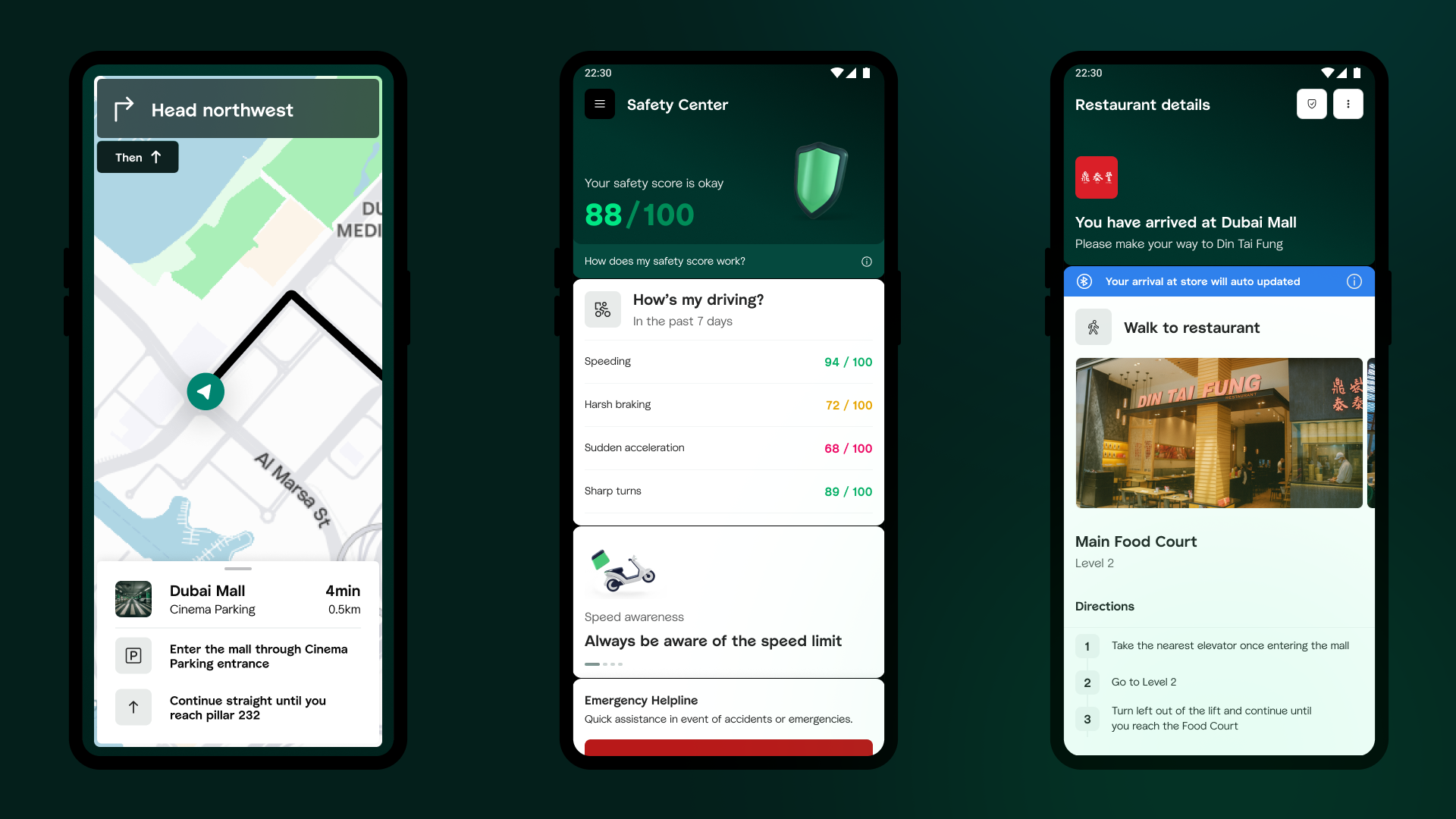
Pre-arrival CET dropped by 1.4 minutes. Captains lost mobile signal entering mall car parks partway through the pilot, so directions were preloaded before Captains reached the dead zone. Arrival confirmation still relied on Captains manually declaring they'd reached the merchant.
Bluetooth beacons
The team had assumed Captains were gaming the arrival button. The actual issue was Captains often weren't sure whether they'd reached the right point. Arrival detection moved from a manual button to passive Bluetooth beacons at merchant sites, removing the need for Captains to self-report at all.
Waiting timer error dropped by about 27 seconds, and downstream ETA models became more reliable once they no longer had to correct for inconsistent manual timestamps.
Telematics
GPS spoofing was affecting roughly 8% of orders, inflating Time to Merchant by around 2.3 minutes and corrupting the models that predicted ETAs. Movement signals originally built for a safety-scoring feature were extended into dispatch and prediction models, making location data harder to manipulate and restoring trust in it across the system.
Outcome
Across the three interventions, Captain engagement efficiency improved by 6 to 9%, and average delivery time dropped by around 3 minutes.
- Year
- 2025
- Team
- Careem